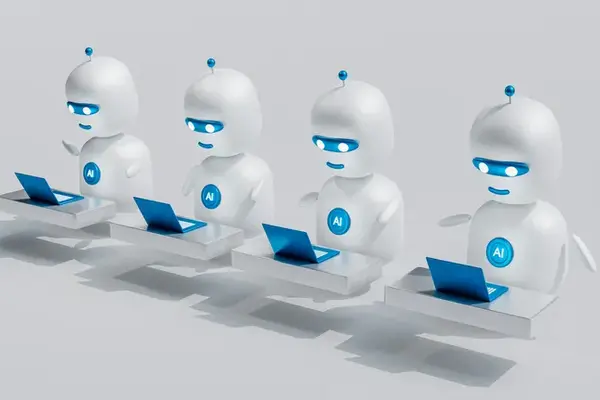

AI is big. No, let me correct the statement. AI is HUGE. It's the topic everyone talks about. From online forums to blogs and social media posts, the Internet is blowing up with AI-powered websites and chatbots. The wave of AI has come—and everyone wants to ride it.
It’s not just a trend; it’s a transformation. AI is reshaping the world of tech, revolutionizing how we work, live, and create. From automating mundane tasks to generating entire marketing campaigns, AI is becoming the silent partner behind every digital experience. In industries like digital marketing, it's unlocking hyper-personalization, predictive analytics, and content generation at scale—things that once took teams of experts now happen in seconds.
And nowhere is this shift more visible than in web design. In the early days, choosing a color palette or font style was often a mix of intuition, trend-following, and a dash of psychology. Designers leaned on established principles—red for urgency, blue for trust, serif fonts for tradition, sans-serif for modernity. But in the age of AI, those rules are no longer static. They’re dynamic, data-driven, and increasingly personalized.
AI tools now analyze user behavior in real time, adapting layouts, colors, and typography to suit individual preferences and emotional states. Websites can shift tone depending on who’s visiting, what device they’re using, or even the time of day. The psychology of design has evolved from broad strokes to fine-tuned emotional intelligence—powered by algorithms that learn and improve with every click.
So, listed below are 5 areas of web design reshaped by artificial intelligence:
1. Color Psychology: From Universal to Personalized
Traditionally, color theory in web design relied on broad psychological associations:
- Red: urgency, passion. Remember Chris de Burgh's "Lady In Red"?
- Blue: trust, calm, corporate. A blue shirt for a white-collar office employee.
- Green: growth, health; the idea of walking barefoot in green grass.
- Black: luxury, sophistication—especially when combined with gold.
But AI has shifted this from a one-size-fits-all model to a context-aware experience:
- User Behavior Analytics: AI tracks how different users respond to color schemes and adapts accordingly.
- Cultural Sensitivity: AI adjusts palettes based on regional preferences or cultural meanings.
- Dark Mode Optimization: AI considers eye strain and user comfort, offering adaptive dark mode options.
2. Typography: The Silent Persuader Goes Smart
Typography has always been a powerful psychological tool:
- Serif fonts: evoke tradition and reliability
- Sans-serif fonts: convey clarity and modernity
- Font size and spacing: influence readability and emotional tone
AI enhances this by:
- Dynamic Font Selection: Adjusting styles and sizes based on device type, user age, or time of day.
- Emotion-Driven Typography: Matching font choices to content sentiment.
- Accessibility Optimization: Ensuring contrast ratios and legibility meet inclusive design standards.
3. Layout and UX: Predictive Psychology in Action
Web design psychology used to rely on heatmaps and A/B testing. Now, AI predicts user behavior before it happens:
- Personalized Layouts: Rearranging content blocks based on user preferences and browsing history.
- Predictive CTAs: Strategically placing call-to-action buttons based on engagement predictions.
- Micro-interactions: Fine-tuning animations and hover effects to match user expectations and emotional states.
4. The New Designer’s Toolkit: Empathy Meets Algorithms
AI doesn’t replace psychological design—it augments it. Designers now collaborate with algorithms that:
- Learn from millions of user interactions
- Adapt designs in real time
- Respect emotional nuance while optimizing performance
The result? Websites that don’t just look good—they feel right.
5. What Lies Ahead: Hyper-Personalized, Emotionally Intelligent Design
Looking ahead, the psychology of web design will be shaped by AI systems that don’t just respond to user behavior—they anticipate it with emotional nuance. We’re entering an era where websites will adapt in real time to a user’s mood, cognitive load, and even biometric feedback. Imagine a site that subtly shifts its color palette to calm a stressed user, or adjusts typography for someone with visual fatigue.
AI will also enable neurodiverse-friendly design, tailoring interfaces for users with ADHD, dyslexia, or sensory sensitivities. As generative models become more sophisticated, designers will collaborate with AI not just to optimize performance, but to craft experiences that feel empathetic, inclusive, and deeply human—even if they’re built by machines. The future of web design psychology isn’t just smart—it’s emotionally aware.
