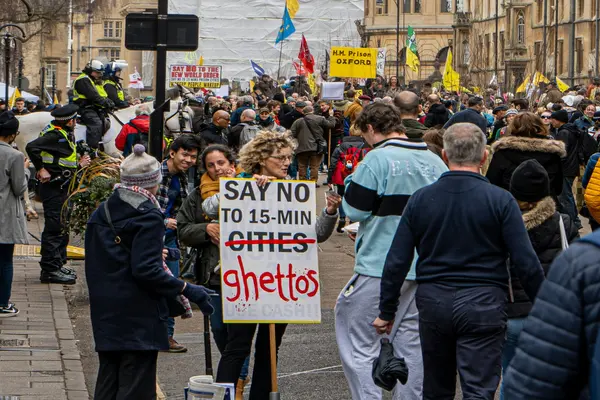

Only few urban planning ideas have caused as much noise in the UK as the concept of the 15‑minute city. Originally designed as a way to make neighbourhoods more walkable, reduce traffic, and improve local services, it has become a lightning rod for controversy — especially when combined with digital traffic monitoring and ANPR enforcement.
Local councils insist the idea is simple: create neighbourhoods where people can access shops, schools, parks, and healthcare within a short walk or cycle. But online, the concept has been framed by some as a plan to restrict movement, enforce “zones”, and track people using cameras.
The BBC and other outlets have reported that misinformation around 15‑minute cities has spread widely, fuelled by confusion over Low Traffic Neighbourhoods (LTNs), traffic filters, and the increasing use of Automatic Number Plate Recognition (ANPR) cameras.
What a 15‑minute city actually is
The idea comes from urban planning research by Professor Carlos Moreno, who proposed that cities should be organised so residents can meet most daily needs within a short walk. It is not a system of checkpoints, digital passes, or restricted zones — but a design philosophy focused on reducing car dependency.
In the UK, councils have adopted elements of the concept through:
- Low Traffic Neighbourhoods (LTNs)
- Traffic filters to reduce through-traffic
- Pedestrianisation of busy streets
- Cycle lanes and active travel routes
These measures are enforced using physical barriers or ANPR cameras — and that’s where the controversy begins.
Digital traffic monitoring: how it works
ANPR cameras are widely used across the UK for traffic enforcement, congestion charging, and monitoring restricted routes. Councils use them to issue fines when drivers pass through restricted areas during certain times.
The cameras record:
- Vehicle registration numbers
- Time and date of passing
- Location of the camera
This data is used to issue penalty notices, manage traffic flow, and enforce restrictions. It does not track individuals or require digital passes — but the presence of cameras has led to public fears about surveillance and movement control.
Where the controversy comes from
The backlash against 15‑minute cities is not really about urban planning — it’s about trust, data, and digital enforcement.
Concerns include:
- ANPR cameras being used to enforce traffic restrictions
- Confusion between LTNs and 15‑minute city planning
- Fears of movement restrictions due to “zones” on council maps
- Misinformation claiming people will need digital passes to travel
The BBC has reported that conspiracy theories have spread widely, with some claiming councils plan to “lock people in their neighbourhoods.” Local authorities have repeatedly denied this, stating that no one will be prevented from travelling.
What councils actually say
Councils implementing LTNs and traffic filters emphasise that:
- People can still drive anywhere they want
- Traffic filters apply only to specific roads, not entire neighbourhoods
- Emergency services have exemptions
- ANPR cameras enforce traffic rules, not personal movement
Oxford City Council, for example, clarified that 15‑minute neighbourhood planning “has nothing to do with restricting movement” and that traffic filters are simply a tool to reduce congestion and improve air quality.
Why the idea became politicised
The concept of 15‑minute cities became entangled with broader debates about:
- Climate policy
- Car ownership
- Digital surveillance
- Local authority powers
Online misinformation blurred the lines between:
- Urban planning
- Traffic enforcement
- Digital monitoring
- Government control
This created a perfect storm where a relatively benign planning concept became a symbol of government overreach for some groups.
Are digital passes or movement permits being introduced?
No UK council has proposed digital movement permits or travel passes for residents. The confusion stems from:
- Maps showing “zones” for planning purposes
- ANPR cameras enforcing traffic filters
- Misinterpretation of consultation documents
Councils have repeatedly stated that people will not be restricted from travelling between neighbourhoods — by car, bus, bike, or on foot.
The final word
15‑minute cities are not about restricting movement — they’re about making neighbourhoods more convenient and less car-dependent. But when combined with digital traffic monitoring, ANPR enforcement, and a lack of clear communication, the concept has become a flashpoint for public distrust.
Until councils improve transparency and engagement, 15‑minute cities will remain one of the most misunderstood — and politicised — planning ideas in the UK.
Read more
The Online Safety Act: Will the UK Force WhatsApp and Signal to Scan Your Messages?Facial Recognition in the UK: Safety Tool or Surveillance Creep?
The NHS Federated Data Platform: Modernisation or a Massive Data Grab?
Predictive Policing in the UK: Smart Technology or Automated Discrimination?
Digital Borders: How AI Is Quietly Transforming UK Immigration Decisions
Smart Meters in the UK: Helpful Upgrade or a New Form of Energy Surveillance?
15‑Minute Cities: Urban Planning Vision or Digital Movement Control?
Britcoin: Modern Money or a Digital Surveillance Tool?
AI in the UK Public Sector: Efficiency Revolution or Mass Job Loss?